

Your Q4 Fulfillment Checklist: How to Get Ready Before the Rush
Every year, I watch brands scramble to figure out fulfillment in October for a peak season that starts in November. Here's the checklist I wish every e-commerce brand owner had in August.
Q4 is where e-commerce brands either make their year or lose it. For a lot of the brands we work with at KTX, November and December account for 30–50% of their annual revenue. That's not unusual — it's how e-commerce works. Black Friday, Cyber Monday, holiday gifting, year-end restocking — it all hits in a 60-day window.
The brands that win Q4 aren't the ones with the best products or the biggest ad budgets. They're the ones whose fulfillment doesn't break under pressure. And that starts months before the first Black Friday order comes in.
I put this checklist together from six years of running peak season fulfillment in DFW. Use it. Print it. Tape it to your wall. It'll save you more money than any marketing tactic you'll deploy this quarter.

August–September: Lock It In
This is the most important window and the one most brands waste. August and September are when you set yourself up to win — or guarantee yourself a stressful November.
3PL relationship:
- If you're switching 3PLs, do it now. Not October. Not "after Labor Day." Now. You need 6–8 weeks minimum to onboard with a new fulfillment partner, transfer inventory, test systems, and work out the kinks before volume spikes.
- If you're staying with your current 3PL, schedule a Q4 planning call. Review their surge capacity, staffing plans, and any rate changes for peak season. Get commitments in writing.
- Confirm your dedicated account rep and escalation path. During peak, you need someone who picks up the phone in minutes, not hours.
Inventory planning:
- Run your demand forecast. Look at last year's Q4 numbers, factor in your growth rate, and account for any new product launches or marketing pushes.
- Place your replenishment orders with manufacturers now. Overseas production lead times are 60–90 days, and delays are worse than usual heading into peak. If you're cutting it close, you're cutting it too close.
- Identify your top 20 SKUs by projected Q4 volume. These need priority placement in the warehouse — closest to packing stations, always fully stocked, never on backorder.
Systems check:
- Test your integrations. Shopify to WMS, Amazon to WMS, Walmart to WMS — whatever channels you're on, run test orders through the full cycle now. Not in November.
- Verify your return addresses, carrier accounts, and shipping settings are all current.
- If you're launching any new SKUs for Q4, get them into the WMS and fully set up with photos, barcodes, and bin locations before October 1.
October: Final Prep
October is your last chance to fix things. Once November hits, you're in execution mode — there's no time to troubleshoot.
Inventory:
- Get all Q4 inventory to your 3PL by mid-October. Receiving takes time — products need to be counted, inspected, barcoded, and put away. If your shipment arrives October 28, it might not be pick-ready until November 5. That's cutting it dangerously close to BFCM.
- Do a full inventory reconciliation with your 3PL. Compare their counts to your system counts. Fix any discrepancies now, not during peak when every unit matters.
- Stage your kitting and bundle components. If you're running gift sets or holiday bundles, all components need to be in-warehouse and pre-kitted before the rush starts.
Staffing and capacity:
- Confirm your 3PL's surge staffing plan. How many additional warehouse workers are they bringing on? When do they start? Have they been trained on your products? For more on Supply Chain Dive on Q4 warehouse labor planning, it's worth reviewing industry benchmarks before your planning call.
- Discuss extended operating hours. During BFCM week, your 3PL should be running extended shifts or multiple shifts to keep up with volume.
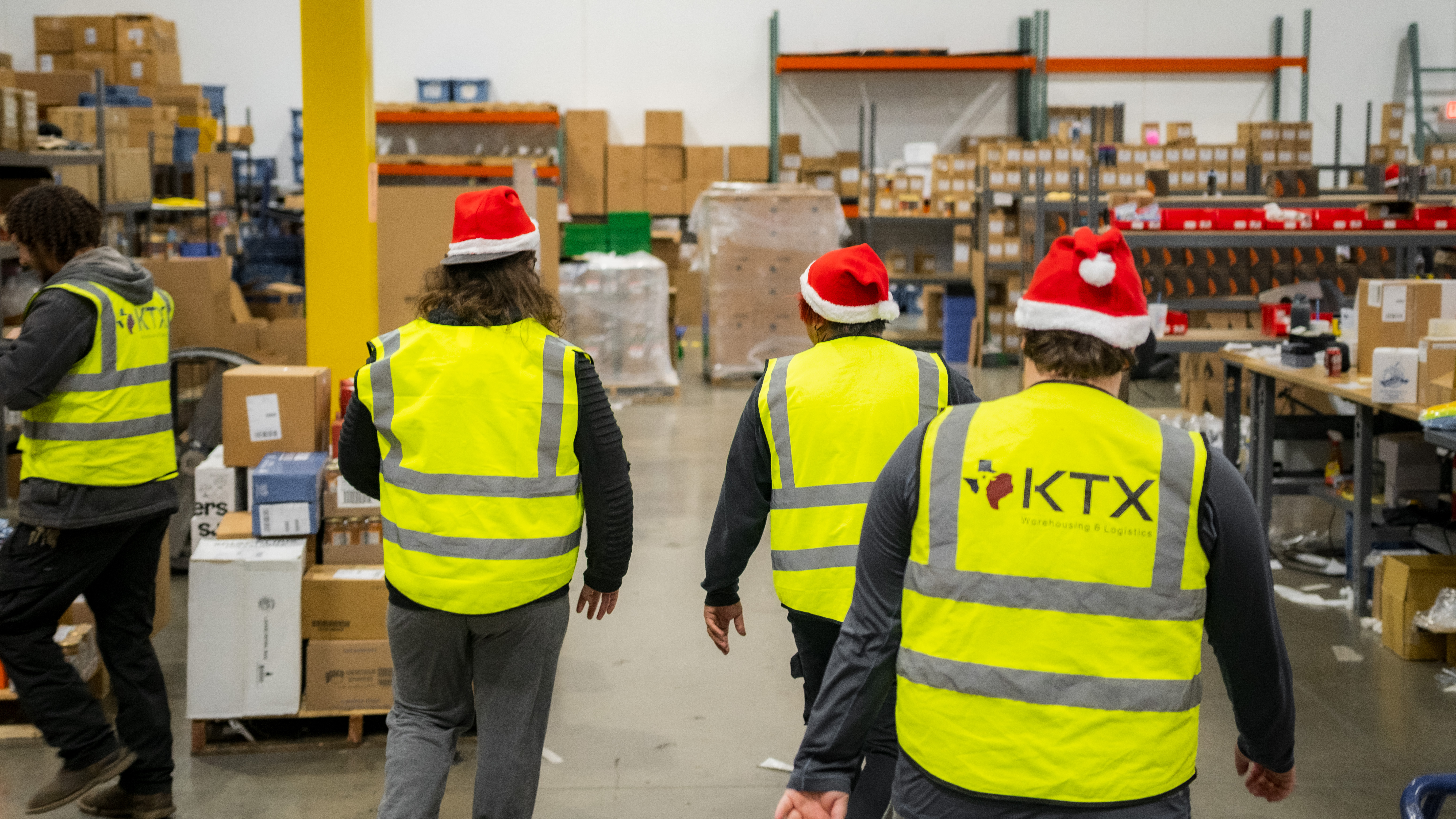
- At KTX, we staff up specifically for peak season across our three DFW facilities. With over 500,000 square feet, we have the physical space to handle surge — but space without trained staff is just empty floor. We plan both.
Returns workflow:
- Confirm your returns process with your 3PL. Holiday returns will start hitting in December and peak in January. Make sure your 3PL knows your disposition rules — what gets restocked, what gets set aside, how refunds are triggered.
- Set up a separate returns receiving area if your volume warrants it. You don't want returns processing to slow down outbound fulfillment.
November–December: Execute and Monitor
This is game time. Your prep is either going to pay off or it isn't. Here's how to stay on top of it.
Daily communication:
- During BFCM week and the two weeks following, you should be in daily contact with your 3PL. Not weekly check-ins — daily. A quick 10-minute call or Slack message covering: orders received, orders shipped, any issues, inventory alerts.
- Set up real-time dashboards if your WMS supports it. At KTX, clients can see their order and inventory status in Warehance at any time — no waiting for end-of-day reports.
SLA monitoring:
- Track these metrics daily during peak:
- Same-day ship rate: What percentage of orders received before cutoff shipped the same day? Should be 98%+ even during surge.
- Pick accuracy: Any increase in mispicks? Catch it early before it compounds.
- Carrier pickup compliance: Are carriers picking up on time? Delays here negate all your warehouse speed.
- Backorder rate: Are any SKUs going out of stock? If so, can you expedite replenishment?
- If any metric drops below your threshold, escalate immediately. During peak, small problems become big problems within hours.
Customer communication:
- Update your shipping estimates on your website. Be honest — if ground shipping is taking 5 days instead of 3 due to carrier congestion, tell your customers. Unmet expectations cause more damage than longer delivery times.
- Set clear order-by dates for holiday delivery. Communicate these across your site, email, and social channels. Check UPS Holiday Shipping Deadlines and FedEx Holiday Shipping Schedule to make sure your posted cutoffs are accurate.
- Have a plan for orders that can't make it by Christmas. Gift cards, digital delivery options, or "your gift is on its way" printable cards can save the sale.
January: Post-Holiday Recovery
Q4 doesn't end on December 31. January is returns season, and how you handle it determines whether you keep the customers you just acquired.
- Returns processing speed: Aim to process returns within 48 hours of receipt. Fast refunds = happy customers who buy again. Slow refunds = chargebacks and one-star reviews.
- Restocking efficiency: Get sellable returned items back into inventory ASAP. Every day a returnable product sits unprocessed is a day you can't sell it.
- Post-mortem with your 3PL: Schedule a Q4 review meeting in mid-January. What went well? What broke? What needs to change for next year? Document everything while it's fresh.
- Data analysis: Pull your Q4 fulfillment metrics — ship times, accuracy, cost per order, return rate by SKU. This data is gold for planning next year's Q4 and for making the case to invest in better fulfillment infrastructure. According to NRF's annual holiday forecast, consumer spending trends during Q4 continue to grow year over year — making post-season analysis more valuable than ever.
"Is It Too Late to Switch 3PLs Before Q4?"

I get this call every year around September, and the honest answer depends on your complexity:
- Simple catalog (under 100 SKUs, one channel): You can switch as late as early October if your new 3PL is experienced and has capacity. It'll be tight, but doable.
- Moderate complexity (100–500 SKUs, multi-channel): September is your realistic deadline. You need time for inventory transfer, integration testing, and at least a few weeks of live orders before volume spikes.
- High complexity (500+ SKUs, kitting, FBA prep, multiple platforms): August or earlier. The more complex your operation, the more time you need to get it right.
If you're reading this in October and thinking "I should have done this two months ago" — call me anyway. We've done emergency onboards before. It's not ideal, but it's better than staying with a 3PL you know is going to fail you during the most important quarter of your year.
For a deeper dive into what to look for in a fulfillment partner, check out How to Choose a 3PL in Dallas. You can also see how KTX handled 10,000 Q4 orders to understand what peak-season execution looks like in practice. For additional preparation strategies, the Inbound Logistics Q4 readiness guide is a solid external resource worth bookmarking.
Make This Your Best Q4
The brands that win peak season aren't lucky — they're prepared. Start now, check every box on this list, and go into November knowing your fulfillment is handled. That's how you focus on marketing, sales, and growth instead of worrying about whether your orders are going out the door.
If you want to talk about Q4 readiness — whether you're already with a 3PL or looking for one — I'm here. Let's make sure this is the quarter your brand levels up.
Talk to KTX about Q4 fulfillment →
Frequently Asked Questions
When should I start preparing for Q4 fulfillment?
August. I know that sounds early, but your Q4 success is determined by decisions you make in August and September — locking in your 3PL relationship, placing inventory replenishment orders, and testing your systems. By October, you should be in final prep mode. By November, there's no time to fix anything that isn't already working.
What's the latest I can switch 3PLs and still be ready for Black Friday?
It depends on your complexity. A simple catalog (under 100 SKUs) can switch as late as early October. Multi-channel operations with hundreds of SKUs should switch by September at the latest. Complex operations with kitting, FBA prep, and multiple platforms need to start the transition in August. If you're past these deadlines, call anyway — we've handled emergency onboards, and a tight timeline is better than a broken peak season.
How does KTX handle surge volume during peak season?
We plan for surge months in advance. That means hiring and training additional warehouse staff before October, extending operating hours during BFCM and the holiday shipping window, and leveraging our three DFW facilities (over 500,000 square feet combined) to spread volume and prevent bottlenecks. We maintain our 99%+ same-day shipping standard even during peak — that's non-negotiable.
What metrics should I track during peak season?
Four metrics, daily: same-day ship rate (should stay above 98%), pick accuracy (watch for any decline from your baseline), carrier pickup compliance (your 3PL ships on time but is the carrier picking up?), and backorder rate (are any SKUs running low?). If any of these moves in the wrong direction, escalate immediately. Small problems during peak become big problems within hours.
How should I handle post-holiday returns?
Aim to process returns within 48 hours of receipt at the warehouse. Fast refunds keep customers happy and reduce chargebacks. Work with your 3PL to separate returns processing from outbound fulfillment so one doesn't slow down the other. And schedule a Q4 post-mortem in mid-January while everything is fresh — document what worked, what broke, and what you'll do differently next year.
What if my inventory doesn't arrive at the warehouse in time?
This is the nightmare scenario, and it happens more often than you'd think — especially with overseas manufacturing. Build a buffer into your timeline: order early, ship early, and have your inventory at your 3PL by mid-October at the latest. If you're tracking a delayed shipment, communicate with your 3PL immediately so they can prioritize receiving when it does arrive. And always have a backup plan for your top-selling SKUs — whether that's a secondary supplier, air freight, or pre-positioning safety stock.
Frequently Asked Questions
- When is the last day to ship for Christmas delivery via UPS and FedEx Ground?
- This changes slightly year to year, but typically UPS and FedEx Ground Christmas delivery cutoffs fall around December 18-19 for most US destinations. Expedited options (2-day, overnight) extend the window to December 23. Your 3PL should have the current-year carrier deadlines posted and should be proactively communicating them to you in November.
- How much additional inventory buffer should I carry for Q4 vs. normal months?
- Industry guidance is to carry 1.5-2x your normal peak-month inventory going into Q4. If your busiest non-Q4 month moves 1,000 units of a SKU, plan for 1,500-2,000 on hand in October to cover the November-December surge. The cost of holding extra inventory for 60 days is almost always lower than the cost of stockouts during peak.
- Should I switch 3PLs before Q4?
- Generally, no — switching mid-year introduces risk right when stability matters most. If your current 3PL is problematic, the smarter timing is to plan a January or February transition after the dust settles. Exceptions: if your current 3PL has already communicated capacity constraints for your Q4 volume, it's worth exploring now while there's still time to move.
- What information should I send my 3PL in August to prepare for Q4?
- Share: (1) your monthly sales forecast by SKU for October-December, (2) any new product launches hitting during Q4, (3) planned promotions and expected volume spikes (Black Friday dates, etc.), (4) whether you need expanded kitting or custom packaging for holiday orders, and (5) your returns policy so the 3PL can prepare for January volume.
- How do I evaluate if my 3PL is Q4-ready?
- Ask them directly: What is your capacity for Q4 vs. normal volume? How do you staff up for peak? What was your accuracy rate last Q4? What carriers are you contracted with for peak capacity? A 3PL that can answer these questions with specifics (not vague reassurances) is in better shape than one that tells you "we handle it every year."
